SEARCH REVIEW BOOK/MATERIAL

Types Of Water Closet

SIPHON-VORTEX
Water enters through diagonal punching around the rim of the bowl, creating a vortex that draws the water down into the rear trap with a swirling action that scours the walls of the bowl. Water strikes two parallel ridges and folds over forming a jet, producing siphonic action. Large water surface provides a very efficient and clean process, and the flushing is extremely quiet. This model is mostly of one-piece construction with a low profile. Expensive.
SIPHON-JET
Water enters through rim punchings and jets placed in an up-leg of the rear trap, filling the trapway and creating an instant siphon action without rise of water level. The result is quick water withdrawal. Large water surface provides an efficient and clean operation. With quiet flushing and moderate cost, this is the most popular residential model.
REVERSE-TRAP
Water enters through rim punchings and through a jet that fills the rear trapway completely, creating a siphon action and resulting in quick withdrawal of water from the bowl. A water jet is located at the inlet of the trapway. Most of the bowl surface is covered with water. This model is efficient but moderately noisy. Its cost is reasonably low.
WASH-DOWN
Water enters through an open rim, as though a bucket of water were dumped into the bowl, filling the front trapway and creating siphon action. This model provides quick removal of water with minimum water rise. Small water surface makes the model more vulnerable to soiling and clogging. This is the least efficient and most noisy type but lowest in cost.
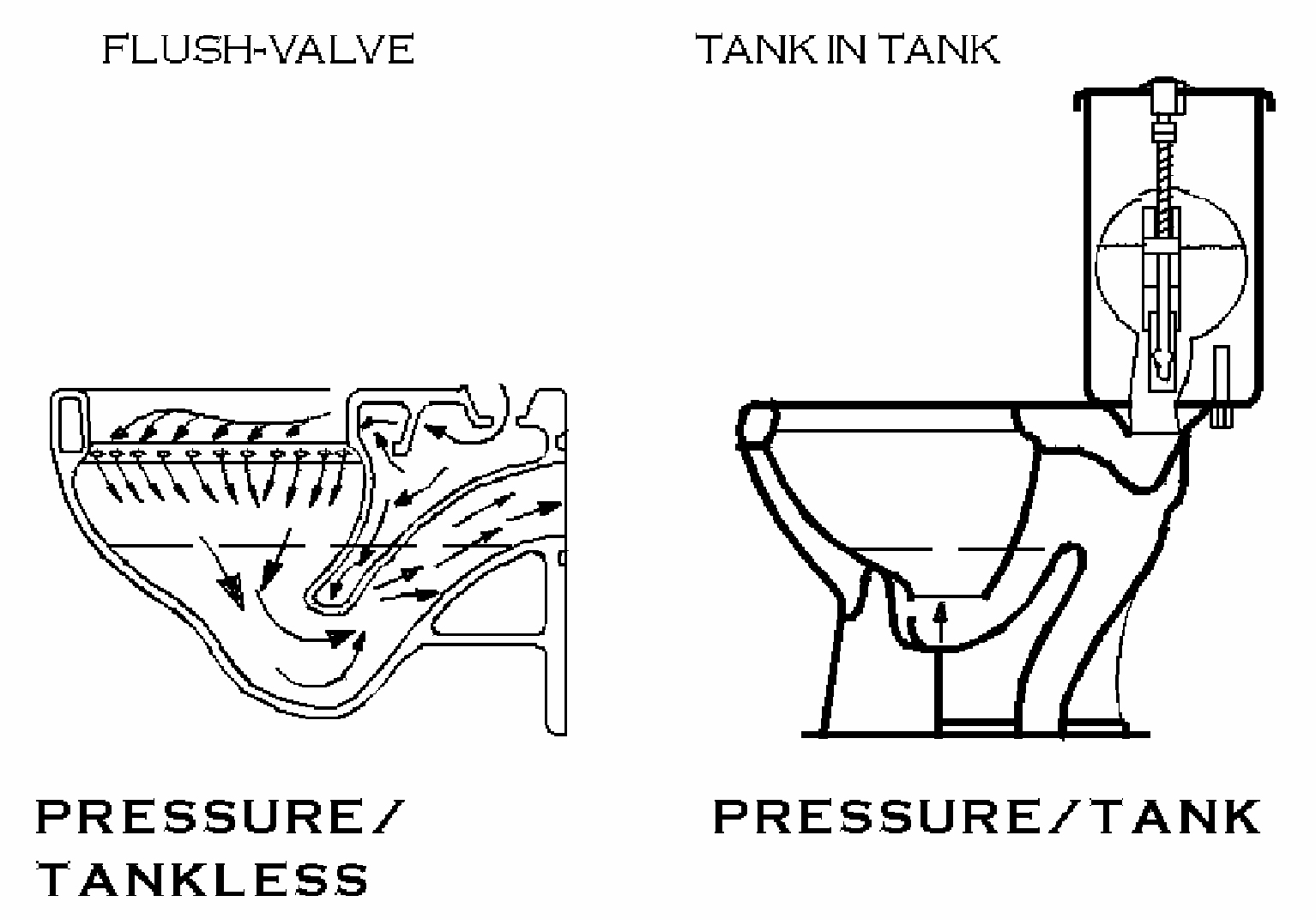
PRESSURE/TANKLESS
Strong flushing action is created by a jet of water directed into the rim and jet. The force of the jet draws the bowl contents into the rear trap. It doesn't use siphonic action but relies on the driving force of jet action. At flush valve 25 psi is needed with 1.5-in. inlet spud. Large water surface and large trapway size make this model efficient and suitable for commercial use. Flushing is very noisy. Expensive.
PRESSURE/TANK
A steel tank is located inside the china tank. Uses pressure from the water supply system. A 1.5 in. water supply line provides 25 psi pressure, compressing trapped air in the tank. When flushed the compressed air forces the water out. The bowl is designed to accept the torrent of water. The crest of the surging water empties the bowl through the enlarged trap. Large water surface makes this model efficient. Design features make it suitable for residential use. Flushing is very noisy. Low water usage (1.5 gpf) helps conserve water. Expensive.


Philippine Pipe Color Code

IDENTIFICATION OF PIPE BY COLOR
NBC Amended Rules and Regulation (PD 1096)
Rule XIII Electrical and Mechanical Regulations

COLOR
MATERIAL PIPED
PIPE IDENTIFICATION


RED
Carbon Dioxide
Carbon Dioxide

Water (Fire Service)
Fire Service Water


ORANGE
Acetylene
Acetylene

Blast Furnace Gas
B.F. Gas

Gasoline
Gasoline

Grease
Grease

Hydrogen
Hydrogen

Oxygen
Oxygen

Oil
Oil

Tar
Tar

Producer Gas
Producer Gas

Liquid Petroleum Gas
LPG

Oil and Water
Oil and Water

Vacuum-High
High Vacuum


YELLOW
Acid
Acid

Air-High Pressure
H.P. Air

Ammonia
Ammonia

Steam-High Pressure
H.P. Steam

Steam-Low Pressure
L.P. Steam

Water-Boiler Feed
Boiler Feed Water

Water-Hot
Hot Water

Water-High Pressure
H.P. Water


GREEN
Air-Low Pressure
L.P. Air

Argon-Low Pressure
L.P. Argon

Helium-Low Pressure
L.P. Helium

Nitrogen-Low Pressure
L.P. Nitrogen

Water-Cold
Cold Water

Water-Distilled
Distilled Water

Water-Low Pressure
L.P. Water

Water-Treated
Treated Water


Oil and Water
Oil and Water
Related Posts Plugin for WordPress, Blogger...